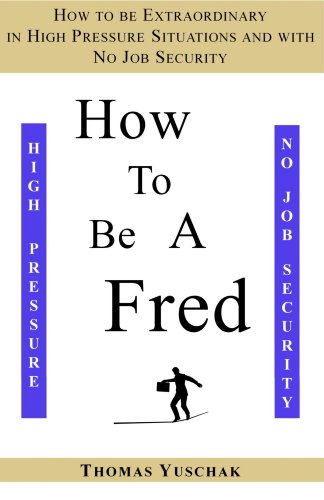
How To Be A Fred by Thomas Yuschak is a quick read. And well worth it.
The concept I wanted to share was how Yuschak defines pressure as different than stress. For me, this was what stuck.
"Stress is a physiological response to pressure but it's not the pressure itself. Pressure sets the level of urgency, the level of importance, the level of visibility."
We aren't so evolved that on some internal level, in our reptilian brains, our reaction to day to day pressure is akin to a lion attacking us. It's important to separate pressure from stress.
It's vital, I would say.
If we separate the two, we can best identify the pressure points from our reaction.
Then we can use the pressure constructively while alleviating life-destroying stress.
3 Key Concepts:
And lastly,
"To avoid letting pressure transform into stress, we'll have to learn to separate our emotions from the pressure we're under."
The way we can do this is to understand our priorities and not allow the day to day to distract us from them. Yuschak suggests we take the time to imagine ourselves looking back on this time. How would we minimize our regrets? What would feel satisfying?
From there we can establish Short Term Life Priorities, and Short Term Career Priorities. We can also establish Long Term priorities in both areas. This will keep us on track.
Perhaps we can all use a little Fred.
Have a great week selling!
If you want to buy the book, get it here.
|

Monday, December 17, 2018
Be a Fred
Monday, December 10, 2018
Santa Clause Rally in Bonds
 | |||||||||||||||||||||||||||||||||||||||||||||||||||||||||||||||||||||||||||||||||||||||||||||||||||||||||||||||||||
This credit union is federally insured by the National Credit Union Administration (NCUA). Accounts and shares are insured by the Administration to the maximum insurance amount for each member or shareholder. Unless otherwise noted, fees may be associated with certain products and services. Certain UNFCU products and services are subject to approval. Federal and state laws may limit the availability of certain products and services in select areas. UNFCU is a registered mark of the United Nations Federal Credit Union.
|




Tuesday, November 27, 2018
Every Deal Is Precious - Be Sure Your Buyer is Pre-Approved!
 |
Follow Me On:
    |
| |||||||||||||
Every Deal Is Precious - Be Sure Your Buyer is Pre-Approved!
It's a changing market.
Buyers are negotiating harder on price, on the removal of tenants, on inspections...on everything.
Sellers don't want to budge on price, on the removal of tenants, on inspections...on anything.
Resilience is so vital in the real estate business today. Perhaps more today than since the crisis back in 2008-2009.
Every deal is precious. Everything needs to be lined up just so to make the deal happen.
Buyers are also aware of the increasing rate environment.
Buyers want to negotiate rates before they find the right home to buy. Makes sense to them.
What if they don't qualify for the rate they negotiated?
What happens when the deal falls out because the buyer wasn't a qualified as they thought?
Get a fully underwritten preapproval before negotiating terms with the seller.
Don't let the next (precious, hard to come by, painstaking) deal fall out because the buyer assumed they were well qualified.
Most lenders will do a fully underwritten preapproval for free. If not, refer them to one who will.
UNFCU offers fully underwritten preapprovals.
The client submits a mortgage application package (income, assets, liabilities) — our NYC based underwriters' review and approval of the application on a pre-approval basis.
We issue the Commitment Letter pending an appraisal - before the negotiations are exhausted!
Now you can negotiate all the details to get the deal into contract without concern for the financing. That is now in place upfront.
I wanted to keep this email short. If this interests you or could help you at this time, please reach out.
You can call me at +1 212-243-0373 or email me at jloyd@unfcu.com. Or check my website at www.unfcu.org/JeffreyL
United Nations Federal Credit Union Niche Residential Mortgage Lending:
Please feel free to delete this email if this doesn't concern you or if I have reached the wrong person by mistake, thank you.
| |||||||||||||
| |||||||||||||




Monday, August 01, 2016
Coffee & Sardines
The morning is crisp and cool. The air is clear. My mind is clear. I open a tin of sardines. I feel pride swell as I think about how much has changed with what and how I eat. My sardines are delicious, a bit dry despite being packed in water. I drink water to wash a bite down.
"Smaller bites," I think as I chew.
I pour another measure of water into the coffee filter. My eyes glance around our simple kitchen. With its wood floors and concrete counter tops. Outside I see the tomato plants are responding to Erika's care and doing very well. I don't even know what kind of tomatoes they are. The best part - don't care. I think about how mushy, juicy and seedy they will be as I cut them. Slicing tomatoes is an elusive art.
I think about the day ahead. After my coffee, I'll help Takei in the field where he grows vegetables. He grows whatever he thinks Yutaka wants, or whatever Yutaka has said he likes. Potatoes, cucumbers green onions, and rice. Plenty of rice. We give lots of the harvest away.
Working with him in the field seems to be a comforting way to start the day. It's satisfying to grow even a small amount of the food we eat. We don't speak much. We don't need to. What needs to be done is simple enough.
My favorite time is the harvesting of the persimmons. We hang them by their stems on a clothes line. They dry. They become delicious. Seeing them hanging by the delicately cut "T" of their stems is peaceful and useful.
As I put on my boots I think about the rest of the day. I am researching visual psychology. It's very interesting what arrests people's behaviors visually.
"I should do a podcast with an expert and use the findings," I say to myself.
I'm outlining a course that I can put together and offer online. Something that would teach others in a simple and meaningful manner. More than an introduction. More of a moderate level.
I have an office away from home. Erika has her Little Happy Things which she prefers to run from home. She likes to switch back and forth between working on that and doing stuff at home. She asks me to go away during the day and I'm happy to oblige. I like to get out a bit.
Sometimes I will walk with Yutaka. His school isn't far. Usually he will take transit or ride his bicycle. Sometimes he will walk with me. Sometimes we will bike together.
As I arrive in my office on the 2nd Floor of a small building. I reflect upon what needs to be done. I have some calls to return. Some calls to make. I'm always on the lookout for great guest for my VR simul cast. We engage in an experience with others as well. There is also a discussion about the VR adaptation of my book. Immersive and thrilling. The team is all over the world so timing is our main concern when scheduling our meetings. This project is what has lead me to some very interesting work and an interest in visual psychology. Learning this platform has been tremendous.
The office is trading floor style. Open, movable and flexible. I leased extra space to use as an incubator. I pick a founder who is smart, passionate and understands his idea Several are there working and conversing. I provide guidance, space, feedback to those working here. Creating leaders is amazing.
I only work for a few hours a day. I like to go home around 2pm to spend some time with Erika before Yutaka gets home around 5:30 - 6pm. This is our time. I've always preferred to have intimacy during the day. So much more delicious.
"Smaller bites," I think as I chew.
I pour another measure of water into the coffee filter. My eyes glance around our simple kitchen. With its wood floors and concrete counter tops. Outside I see the tomato plants are responding to Erika's care and doing very well. I don't even know what kind of tomatoes they are. The best part - don't care. I think about how mushy, juicy and seedy they will be as I cut them. Slicing tomatoes is an elusive art.
I think about the day ahead. After my coffee, I'll help Takei in the field where he grows vegetables. He grows whatever he thinks Yutaka wants, or whatever Yutaka has said he likes. Potatoes, cucumbers green onions, and rice. Plenty of rice. We give lots of the harvest away.
Working with him in the field seems to be a comforting way to start the day. It's satisfying to grow even a small amount of the food we eat. We don't speak much. We don't need to. What needs to be done is simple enough.
My favorite time is the harvesting of the persimmons. We hang them by their stems on a clothes line. They dry. They become delicious. Seeing them hanging by the delicately cut "T" of their stems is peaceful and useful.
As I put on my boots I think about the rest of the day. I am researching visual psychology. It's very interesting what arrests people's behaviors visually.
"I should do a podcast with an expert and use the findings," I say to myself.
I'm outlining a course that I can put together and offer online. Something that would teach others in a simple and meaningful manner. More than an introduction. More of a moderate level.
I have an office away from home. Erika has her Little Happy Things which she prefers to run from home. She likes to switch back and forth between working on that and doing stuff at home. She asks me to go away during the day and I'm happy to oblige. I like to get out a bit.
Sometimes I will walk with Yutaka. His school isn't far. Usually he will take transit or ride his bicycle. Sometimes he will walk with me. Sometimes we will bike together.
As I arrive in my office on the 2nd Floor of a small building. I reflect upon what needs to be done. I have some calls to return. Some calls to make. I'm always on the lookout for great guest for my VR simul cast. We engage in an experience with others as well. There is also a discussion about the VR adaptation of my book. Immersive and thrilling. The team is all over the world so timing is our main concern when scheduling our meetings. This project is what has lead me to some very interesting work and an interest in visual psychology. Learning this platform has been tremendous.
The office is trading floor style. Open, movable and flexible. I leased extra space to use as an incubator. I pick a founder who is smart, passionate and understands his idea Several are there working and conversing. I provide guidance, space, feedback to those working here. Creating leaders is amazing.
I only work for a few hours a day. I like to go home around 2pm to spend some time with Erika before Yutaka gets home around 5:30 - 6pm. This is our time. I've always preferred to have intimacy during the day. So much more delicious.
Sunday, October 04, 2015
Stoicism is a key way to handle this business
I'd like to begin a series of studies on how to interpret the Stoic philosophers in the context of the mortgage business. The main way is to fully accept operations and documentation requests as being exactly how they are supposed to be.
If we can completely embody this viewpoint, and project our view confidently to our clients, we may have a better time managing their expectations with the process.
I'll do some homework and come up with a few applicable quotes.
Wednesday, July 23, 2014
First Things First
I've had a little experience with the real estate broker world. My mother was one. I have a license in my state, have had one since around 2006. I have a broker's license in fact.
First off, I'm going to demise the entity of Metropolitan Real Estate Group, and merge the broker's license over to Jeffrey Loyd & Associates LLC another entity that I have. I have feedback from a trusted advisor that this is the route to go. Metropolitan is certainly not wowing me in the branding department, so why not?
Now that I've made that decision, I'm going to have to establish that as the real estate brokerage entity. Tomorrow I call the New York State Department of State to begin necessary arrangements.
Meanwhile, I'm say a little something about how I plan to operate.
First of all, I plan to do commercial real estate only. I do not want to get involved in residential real estate even in this market. I do not plan to do things in the traditional manner. I don't want to list properties for sale, nor do I want to drag customers around looking at buildings.
What I want to do is work the phones, day after day (Monday through Friday) and with careful scripting, a robust CRM, a targeted area of concentration (geographic), and try to get enough people interested in buying or selling that I can effect a match. Or a meeting of the minds as they say.
Do I have all of this mapped out yet? No I do not.
Do I think this will be easy? No I do not.
Do I think that I can earn $ in this manner. Yes I do. It well suited to my personality.
First off, I'm going to demise the entity of Metropolitan Real Estate Group, and merge the broker's license over to Jeffrey Loyd & Associates LLC another entity that I have. I have feedback from a trusted advisor that this is the route to go. Metropolitan is certainly not wowing me in the branding department, so why not?
Now that I've made that decision, I'm going to have to establish that as the real estate brokerage entity. Tomorrow I call the New York State Department of State to begin necessary arrangements.
Meanwhile, I'm say a little something about how I plan to operate.
First of all, I plan to do commercial real estate only. I do not want to get involved in residential real estate even in this market. I do not plan to do things in the traditional manner. I don't want to list properties for sale, nor do I want to drag customers around looking at buildings.
What I want to do is work the phones, day after day (Monday through Friday) and with careful scripting, a robust CRM, a targeted area of concentration (geographic), and try to get enough people interested in buying or selling that I can effect a match. Or a meeting of the minds as they say.
Do I have all of this mapped out yet? No I do not.
Do I think this will be easy? No I do not.
Do I think that I can earn $ in this manner. Yes I do. It well suited to my personality.
Mortgage Business is a Drag
I'm making money doing loans for a big bank and I just cannot see doing it for much longer. The mortgage business is broken, very broken. No one likes it, least of all the banking customers who have to put up with it.
I'm thinking very seriously about moving into commercial real estate. I'm going to use this blog to develop my business plan. To craft my scripting and generally keep my notes in one place.
One public place.
Perhaps I will help someone in a similar situation, most likely not.
Perhaps I will receive some constructive criticism, most likely not.
Let's get started.
I'm thinking very seriously about moving into commercial real estate. I'm going to use this blog to develop my business plan. To craft my scripting and generally keep my notes in one place.
One public place.
Perhaps I will help someone in a similar situation, most likely not.
Perhaps I will receive some constructive criticism, most likely not.
Let's get started.
Tuesday, July 16, 2013
VIGODA - A Vignette for Film
Open on an office, a room full of cubicles, there are 5 young staffers (Courtney, Judd, Noble, Cindy and Ting) huddled around one young (Ryan) man at his desk.
Ryan: I called it the VIGODA Courtney: After Abe? Ryan: Huh? Judd (to Courtney): He doesn't know Courtney nods and scowls at Ryan Ryan: Know what? Courtney: You have no pop culture. Abe Vigoda was a...ah it doesn't matter, why do you call VIGODA? Ryan: It stands for Velocity In Gain Or Decrease Algorithm. It attempts to measure the speed at which a candidate's polling will increase or decrease in left leaning or right leaning districts, but not solid left or solid right districts. I'm trying to get a handle on at what point, the candidate gains traction or should be considered a loss for that district. Telephone rings on Ryan's desk. He answers. Ryan: (checking watch). He's right on time. OK, I'll be right there. (Hangs up telephone). OK, Barnes is here, I gotta do this. Cindy: The beacon of New Hampshire. How did you pull the interview? Ryan: (grabbing suit jacket from the back of the chair) Just luck I guess.
Conference Room (not large, speaker phone in the middle of the table. TV mounted on one wall, 6 chairs) Receptionist opens the door and shows an African American man wearing an American flag pin in his lapel into the room. Receptonist: Mr. Barnes, please have a seat anywhere you like. May I bring you anything? Roy Barnes: No, I'm fine, thanks.
Roy Barnes is the African American Republican candidate for an New Hampshire district where he is polling high and seems to be the one to beat. He is well groomed, well spoken, and obviously works out regularly. He is often photographed running or swimming, with his body on full display.
The door to conference room opens and Ryan, a young African American male hurriedly walks in. He is wearing a suit carelessly in contrast to Roy Barnes' meticulous stylish, yet conservative attire. Ryan approaches Roy with an outstretched hand. Ryan: Mr. Barnes, it's nice to meet you. I'm Ryan Hattern and I'll be conducting this interview on behalf of Thom Roy Barnes: You know (flexing arm) I work out a lot. Do you?
Barnes: Yeah, you look it. Where? I go to SportsClub so that I have access when I travel. Also they have an excellent steam room. You ever go there?
Ryan: Looking at his note to prepare for the interview Shakes head
Barnes: You should (leans back, and rubs his stomach) it feels great to take a nice long steam. I have some guest passes if you would like to check it out. Perhaps we could get a workout in too.
Ryan: Nods
Ryan: Ah, I'm pretty busy right now. So you are originally from Boston, is that correct?
Barnes: Yeah, I grew up in New Hampshire though. My family moved when I was 11. We own a farm up there. Majestic beauty, away from everything.
Ryan: And this is your first entry into politics?
Barnes: Yep, my first go.
Ryan: Can you tell me why you are running for office aside from the campaign rhetoric?
Barnes: What do you think about hitting the gym tonight?
Ryan: I called it the VIGODA Courtney: After Abe? Ryan: Huh? Judd (to Courtney): He doesn't know Courtney nods and scowls at Ryan Ryan: Know what? Courtney: You have no pop culture. Abe Vigoda was a...ah it doesn't matter, why do you call VIGODA? Ryan: It stands for Velocity In Gain Or Decrease Algorithm. It attempts to measure the speed at which a candidate's polling will increase or decrease in left leaning or right leaning districts, but not solid left or solid right districts. I'm trying to get a handle on at what point, the candidate gains traction or should be considered a loss for that district. Telephone rings on Ryan's desk. He answers. Ryan: (checking watch). He's right on time. OK, I'll be right there. (Hangs up telephone). OK, Barnes is here, I gotta do this. Cindy: The beacon of New Hampshire. How did you pull the interview? Ryan: (grabbing suit jacket from the back of the chair) Just luck I guess.
Conference Room (not large, speaker phone in the middle of the table. TV mounted on one wall, 6 chairs) Receptionist opens the door and shows an African American man wearing an American flag pin in his lapel into the room. Receptonist: Mr. Barnes, please have a seat anywhere you like. May I bring you anything? Roy Barnes: No, I'm fine, thanks.
Roy Barnes is the African American Republican candidate for an New Hampshire district where he is polling high and seems to be the one to beat. He is well groomed, well spoken, and obviously works out regularly. He is often photographed running or swimming, with his body on full display.
The door to conference room opens and Ryan, a young African American male hurriedly walks in. He is wearing a suit carelessly in contrast to Roy Barnes' meticulous stylish, yet conservative attire. Ryan approaches Roy with an outstretched hand. Ryan: Mr. Barnes, it's nice to meet you. I'm Ryan Hattern and I'll be conducting this interview on behalf of Thom Roy Barnes: You know (flexing arm) I work out a lot. Do you?
Barnes: Yeah, you look it. Where? I go to SportsClub so that I have access when I travel. Also they have an excellent steam room. You ever go there?
Ryan: Looking at his note to prepare for the interview Shakes head
Barnes: You should (leans back, and rubs his stomach) it feels great to take a nice long steam. I have some guest passes if you would like to check it out. Perhaps we could get a workout in too.
Ryan: Nods
Ryan: Ah, I'm pretty busy right now. So you are originally from Boston, is that correct?
Barnes: Yeah, I grew up in New Hampshire though. My family moved when I was 11. We own a farm up there. Majestic beauty, away from everything.
Ryan: And this is your first entry into politics?
Barnes: Yep, my first go.
Ryan: Can you tell me why you are running for office aside from the campaign rhetoric?
Barnes: What do you think about hitting the gym tonight?


Tuesday, July 05, 2011
Fewer Borrowers & fewer qualify
I'm probably the last to say it, but while rates are at an all time low, it seems that very few can qualify. The ones that can seemed to have had their head in the sand for the past year or so. For unknown reasons, they just didn't refinance at any previous time. Maybe they were waiting for rates to get lower, not much chance of that according to the smart folks who opine on such things as inflation and the economy. Maybe they were waiting for their home to increase in value? The good people at Case-Shiller say, "fat chance." Maybe they were hoping their income would rise? It seems that's not going to happen that much either as corporations have been given the green light to hold the profits and pay the executives more without increasing the pay of the minions working tirelessly.
I know this comes off as negative, but where's the upside?
Sunday, September 19, 2010
MI Companies are back to making money, so why aren't they doing more
The mortgage insurance companies' losses are getting less and less.
According to WSJ, there are 10 reasons to buy a home
A Wall Street Journal blog article outlines 10 reasons to buy a home now. Take a look. For the full article, click here.
Enough with the doom and gloom about homeownership.
Sure, maybe there's more pain to come in the housing market. But when Time magazine starts running covers that declare "Owning a home may no longer make economic sense," it's time to say: Enough is enough. This is what "capitulation" looks like. Everyone has given up.
After all, at the peak of the bubble five years ago, Time had a different take. "Home Sweet Home," declared its cover then, as it celebrated the boom and asked: "Will your house make you rich?"
But it's not enough just to be contrarian. So here are 10 reasons why it's good to buy a home.
1. You can get a good deal. Especially if you play hardball. This is a buyer's market. Most of the other buyers have now vanished, as the tax credits on purchases have just expired. We're four to five years into the biggest housing bust in modern history. And prices have come down a long way– about 30% from their peak, according to Standard & Poor's Case-Shiller Index, which tracks home prices in 20 big cities. Yes, it's mixed. New York is only down 20%. Arizona has halved. Will prices fall further? Sure, they could. You'll never catch the bottom. It doesn't really matter so much in the long haul.
Where is fair value? Fund manager Jeremy Grantham at GMO, who predicted the bust with remarkable accuracy, said two years ago that home prices needed to fall another 17% to reach fair value in relation to household incomes. Case-Shiller since then: Down 18%.
Brett Arends discusses why he thinks now is a particularly good time to buy a home.
2. Mortgages are cheap. You can get a 30-year loan for around 4.3%. What's not to like? These are the lowest rates on record. As recently as two years ago they were about 6.3%. That drop slashes your monthly repayment by a fifth. If inflation picks up, you won't see these mortgage rates again in your lifetime. And if we get deflation, and rates fall further, you can refi.
3. You'll save on taxes. You can deduct the mortgage interest from your income taxes. You can deduct your real estate taxes. And you'll get a tax break on capital gains–if any–when you sell. Sure, you'll need to do your math. You'll only get the income tax break if you itemize your deductions, and many people may be better off taking the standard deduction instead. The breaks are more valuable the more you earn, and the bigger your mortgage. But many people will find that these tax breaks mean owning costs them less, often a lot less, than renting.
4. It'll be yours. You can have the kitchen and bathrooms you want. You can move the walls, build an extension–zoning permitted–or paint everything bright orange. Few landlords are so indulgent; for renters, these types of changes are often impossible. You'll feel better about your own place if you own it than if you rent. Many years ago, when I was working for a political campaign in England, I toured a working-class northern town. Mrs. Thatcher had just begun selling off public housing to the tenants. "You can tell the ones that have been bought," said my local guide. "They've painted the front door. It's the first thing people do when they buy." It was a small sign that said something big.
5. You'll get a better home. In many parts of the country it can be really hard to find a good rental. All the best places are sold as condos. Money talks. Once again, this is a case by case issue: In Miami right now there are so many vacant luxury condos that owners will rent them out for a fraction of the cost of owning. But few places are so favored. Generally speaking, if you want the best home in the best neighborhood, you're better off buying.
6. It offers some inflation protection. No, it's not perfect. But studies by Professor Karl "Chip" Case (of Case-Shiller), and others, suggest that over the long-term housing has tended to beat inflation by a couple of percentage points a year. That's valuable inflation insurance, especially if you're young and raising a family and thinking about the next 30 or 40 years. In the recent past, inflation-protected government bonds, or TIPS, offered an easier form of inflation insurance. But yields there have plummeted of late. That also makes homeownership look a little better by contrast.
7. It's risk capital. No, your home isn't the stock market and you shouldn't view it as the way to get rich. But if the economy does surprise us all and start booming, sooner or later real estate prices will head up again, too. One lesson from the last few years is that stocks are incredibly hard for most normal people to own in large quantities–for practical as well as psychological reasons. Equity in a home is another way of linking part of your portfolio to the long-term growth of the economy–if it happens–and still managing to sleep at night.
8. It's forced savings. If you can rent an apartment for $2,000 month instead of buying one for $2,400 a month, renting may make sense. But will you save that $400 for your future? A lot of people won't. Most, I dare say. Once again, you have to do your math, but the part of your mortgage payment that goes to principal repayment isn't a cost. You're just paying yourself by building equity. As a forced monthly saving, it's a good discipline.
9. There is a lot to choose from. There is a glut of homes in most of the country. The National Association of Realtors puts the current inventory at around 4 million homes. That's below last year's peak, but well above typical levels, and enough for about a year's worth of sales. More keeping coming onto the market, too, as the banks slowly unload their inventory of unsold properties. That means great choice, as well as great prices.
10. Sooner or later, the market will clear. Demand and supply will meet. The population is forecast to grow by more than 100 million people over the next 40 years. That means maybe 40 million new households looking for homes. Meanwhile, this housing glut will work itself out. Many of the homes will be bought. But many more will simply be destroyed–either deliberately, or by inaction. This is already happening. Even two years ago, when I toured the housing slump in western Florida, I saw bankrupt condo developments that were fast becoming derelict. And, finally, a lot of the "glut" simply won't matter: It's concentrated in a few areas, like Florida and Nevada. Unless you live there, the glut won't have any long-term impact on housing supply in your town.
Write to Brett Arends at the Wall Street Journal for more information about this article.
Enough with the doom and gloom about homeownership.
Sure, maybe there's more pain to come in the housing market. But when Time magazine starts running covers that declare "Owning a home may no longer make economic sense," it's time to say: Enough is enough. This is what "capitulation" looks like. Everyone has given up.
After all, at the peak of the bubble five years ago, Time had a different take. "Home Sweet Home," declared its cover then, as it celebrated the boom and asked: "Will your house make you rich?"
But it's not enough just to be contrarian. So here are 10 reasons why it's good to buy a home.
1. You can get a good deal. Especially if you play hardball. This is a buyer's market. Most of the other buyers have now vanished, as the tax credits on purchases have just expired. We're four to five years into the biggest housing bust in modern history. And prices have come down a long way– about 30% from their peak, according to Standard & Poor's Case-Shiller Index, which tracks home prices in 20 big cities. Yes, it's mixed. New York is only down 20%. Arizona has halved. Will prices fall further? Sure, they could. You'll never catch the bottom. It doesn't really matter so much in the long haul.
Where is fair value? Fund manager Jeremy Grantham at GMO, who predicted the bust with remarkable accuracy, said two years ago that home prices needed to fall another 17% to reach fair value in relation to household incomes. Case-Shiller since then: Down 18%.
Brett Arends discusses why he thinks now is a particularly good time to buy a home.
2. Mortgages are cheap. You can get a 30-year loan for around 4.3%. What's not to like? These are the lowest rates on record. As recently as two years ago they were about 6.3%. That drop slashes your monthly repayment by a fifth. If inflation picks up, you won't see these mortgage rates again in your lifetime. And if we get deflation, and rates fall further, you can refi.
3. You'll save on taxes. You can deduct the mortgage interest from your income taxes. You can deduct your real estate taxes. And you'll get a tax break on capital gains–if any–when you sell. Sure, you'll need to do your math. You'll only get the income tax break if you itemize your deductions, and many people may be better off taking the standard deduction instead. The breaks are more valuable the more you earn, and the bigger your mortgage. But many people will find that these tax breaks mean owning costs them less, often a lot less, than renting.
4. It'll be yours. You can have the kitchen and bathrooms you want. You can move the walls, build an extension–zoning permitted–or paint everything bright orange. Few landlords are so indulgent; for renters, these types of changes are often impossible. You'll feel better about your own place if you own it than if you rent. Many years ago, when I was working for a political campaign in England, I toured a working-class northern town. Mrs. Thatcher had just begun selling off public housing to the tenants. "You can tell the ones that have been bought," said my local guide. "They've painted the front door. It's the first thing people do when they buy." It was a small sign that said something big.
5. You'll get a better home. In many parts of the country it can be really hard to find a good rental. All the best places are sold as condos. Money talks. Once again, this is a case by case issue: In Miami right now there are so many vacant luxury condos that owners will rent them out for a fraction of the cost of owning. But few places are so favored. Generally speaking, if you want the best home in the best neighborhood, you're better off buying.
6. It offers some inflation protection. No, it's not perfect. But studies by Professor Karl "Chip" Case (of Case-Shiller), and others, suggest that over the long-term housing has tended to beat inflation by a couple of percentage points a year. That's valuable inflation insurance, especially if you're young and raising a family and thinking about the next 30 or 40 years. In the recent past, inflation-protected government bonds, or TIPS, offered an easier form of inflation insurance. But yields there have plummeted of late. That also makes homeownership look a little better by contrast.
7. It's risk capital. No, your home isn't the stock market and you shouldn't view it as the way to get rich. But if the economy does surprise us all and start booming, sooner or later real estate prices will head up again, too. One lesson from the last few years is that stocks are incredibly hard for most normal people to own in large quantities–for practical as well as psychological reasons. Equity in a home is another way of linking part of your portfolio to the long-term growth of the economy–if it happens–and still managing to sleep at night.
8. It's forced savings. If you can rent an apartment for $2,000 month instead of buying one for $2,400 a month, renting may make sense. But will you save that $400 for your future? A lot of people won't. Most, I dare say. Once again, you have to do your math, but the part of your mortgage payment that goes to principal repayment isn't a cost. You're just paying yourself by building equity. As a forced monthly saving, it's a good discipline.
9. There is a lot to choose from. There is a glut of homes in most of the country. The National Association of Realtors puts the current inventory at around 4 million homes. That's below last year's peak, but well above typical levels, and enough for about a year's worth of sales. More keeping coming onto the market, too, as the banks slowly unload their inventory of unsold properties. That means great choice, as well as great prices.
10. Sooner or later, the market will clear. Demand and supply will meet. The population is forecast to grow by more than 100 million people over the next 40 years. That means maybe 40 million new households looking for homes. Meanwhile, this housing glut will work itself out. Many of the homes will be bought. But many more will simply be destroyed–either deliberately, or by inaction. This is already happening. Even two years ago, when I toured the housing slump in western Florida, I saw bankrupt condo developments that were fast becoming derelict. And, finally, a lot of the "glut" simply won't matter: It's concentrated in a few areas, like Florida and Nevada. Unless you live there, the glut won't have any long-term impact on housing supply in your town.
Write to Brett Arends at the Wall Street Journal for more information about this article.
Friday, May 21, 2010
Sunday, May 02, 2010
Shortenin' Bread
Now that I've read Michael Lewis' The Big Short, read the recipe for a CDO short done by Dr. Mike Burry that he graciously left on his now closed money management firm's website, I think I have an idea about the Goldman Sachs case that is in the news. According to the individuals in Lewis' book, Goldman hadn't thought of shorting their CDOs and thought that these buyers were the dumb money until they figured out where the smart money was.
Another interesting aspect to this whole debacle is that CDO exist, on some level, because the army of originators on the street (such as me) couldn't provide enough debt to consumers to supply the machine's need for ABS (Asset Backed Securities), so they came up with CDOs, and then synthetic CDOs.
Another interesting aspect to this whole debacle is that CDO exist, on some level, because the army of originators on the street (such as me) couldn't provide enough debt to consumers to supply the machine's need for ABS (Asset Backed Securities), so they came up with CDOs, and then synthetic CDOs.
Saturday, February 13, 2010
New Year, New Deal? Hardly
This year is shaping up to be one of the hardest yet in the mortgag business. There's going be many, many more REOs (foreclosed houses that the bank owns) on the banks' books, likely driving prices downward further.
That's not the problem if that increases buying activity, but with double digit unemployment (real unemployment), uncertainty, tightening underwriting standards, destabilizing appraised values and unknowns yet to come, it seems like a good year to hide under the desk if you are a Loan Officer.
Even good Loan Officers are heading for the hills, and here in NYC, they are jumping from bank to bank seeking greener grass that likely doesn't exist. Files are stacking up against the weight of regulations, underwriting that requires over documentation, and audit after audit of every file. Jumbos and High Balance Conforming loans are seeing the worst of it, but conforming loans can be painful too.
This business is tough, 7 days a week tough, but, sick as it may seem, I enjoy it.
That's not the problem if that increases buying activity, but with double digit unemployment (real unemployment), uncertainty, tightening underwriting standards, destabilizing appraised values and unknowns yet to come, it seems like a good year to hide under the desk if you are a Loan Officer.
Even good Loan Officers are heading for the hills, and here in NYC, they are jumping from bank to bank seeking greener grass that likely doesn't exist. Files are stacking up against the weight of regulations, underwriting that requires over documentation, and audit after audit of every file. Jumbos and High Balance Conforming loans are seeing the worst of it, but conforming loans can be painful too.
This business is tough, 7 days a week tough, but, sick as it may seem, I enjoy it.
Saturday, December 05, 2009
Fannie & Freddie are pushing more loans back to lenders
According to WSJ, Fannie and Freddie are making banks buy back poorly underwritten loans that have soured.
No wonder we have pre-closing audits, pre-funding audits, post-closing audits, post-post closing audits and so on and so forth. The documentation that borrowers must provide almost never ends at this point. Properly prepare borrowers for the onslaught of documentation requests. Banks don't want loans on their books when they could have sold it to Fan/ Fred.
No wonder we have pre-closing audits, pre-funding audits, post-closing audits, post-post closing audits and so on and so forth. The documentation that borrowers must provide almost never ends at this point. Properly prepare borrowers for the onslaught of documentation requests. Banks don't want loans on their books when they could have sold it to Fan/ Fred.
FHA Loosening Condo Approval Guidelines
Haven't posted in awhile. Business has been pretty good lately, despite all the whining I do on this blog.
FHA is changing some of their condo guidelines which should play well in the NYC market. First off, they are lowering the required pre-sales to 30% which will help many of the new developments offer FHA loans until they reach that magic 51-70% threshold needed for FNMA approval. Another nice thing is that they are willing to allow condos with a right of first refusal clause in their by-laws if it's shown that it's not used for discrimination. That will play well in NYC where almost all of the condos have this clause.
There are a few pull backs in the new guidelines as well, such as a 50% concentration limit, and the requirement that the condo be transferred into the hands of the Homeownwer's Association 12 months from the time of the first sale. This doesn't matter as much to existing condo buildings, but new development condos will hate it since they may not be finished with construction within that timeframe.
All in all, I say "thanks."
FHA is changing some of their condo guidelines which should play well in the NYC market. First off, they are lowering the required pre-sales to 30% which will help many of the new developments offer FHA loans until they reach that magic 51-70% threshold needed for FNMA approval. Another nice thing is that they are willing to allow condos with a right of first refusal clause in their by-laws if it's shown that it's not used for discrimination. That will play well in NYC where almost all of the condos have this clause.
There are a few pull backs in the new guidelines as well, such as a 50% concentration limit, and the requirement that the condo be transferred into the hands of the Homeownwer's Association 12 months from the time of the first sale. This doesn't matter as much to existing condo buildings, but new development condos will hate it since they may not be finished with construction within that timeframe.
All in all, I say "thanks."
Subscribe to:
Posts (Atom)